
Why Small Businesses Lose Money Due to Poor GST Billing Systems in 2026–2027? Complete Guide on ITC Loss, Compliance Errors, Cash Flow Leakage
Are GST billing mistakes silently draining your profits? Learn why poor GST systems cause ITC loss, penalties, cash flow issues, and compliance risks, along with expert solutions to build accurate, scalable billing and financial control.
ACCOUNTING & BOOKKEEPING
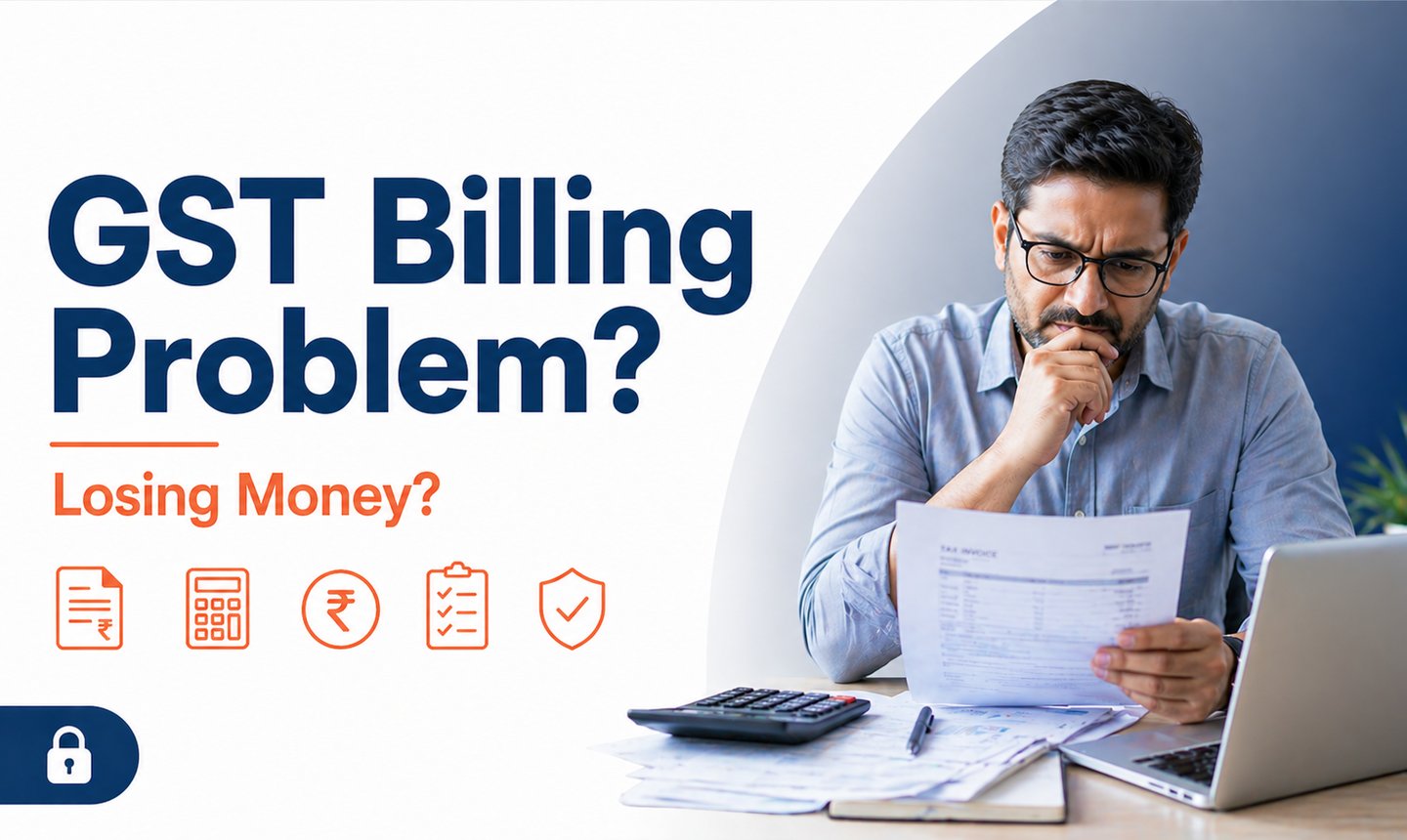

Small businesses do not usually lose money because of low sales.
They lose money because their GST billing system is not structured, not reconciled, and not aligned with compliance requirements.
This problem is more common than most business owners realize. In many cases, losses are not visible immediately. They appear slowly in the form of cash flow pressure, higher tax liability, and compliance issues.
What a “poor GST billing system” actually means
It is not just about using the wrong software.
It usually means:
Incorrect or inconsistent invoice creation
Wrong GST rate or classification
No linkage between billing and accounting
No reconciliation with GST returns
No validation of Input Tax Credit (ITC)
When billing is weak, everything built on top of it becomes unreliable.
Why small businesses are losing money
1. Loss of Input Tax Credit (ITC)
This is the biggest hidden loss.
When billing is incorrect:
ITC is not claimed properly
ITC does not appear in GSTR-2B
Ineligible credit is claimed and later reversed
This leads to:
Higher tax payments
Direct impact on cash flow
2. GST mismatches leading to notices and penalties
Mismatch between:
Sales invoices (GSTR-1)
Tax liability (GSTR-3B)
Books of accounts
triggers system-generated notices.
These issues arise because billing is not aligned with reporting.
3. Incorrect GST rates and classification
Applying the wrong GST rate or HSN/SAC code results in:
Underpayment or overpayment of tax
Compliance risks
Financial losses over time
These errors often go unnoticed until scrutiny.
4. Poor cash flow planning due to wrong billing
When billing is not structured:
Tax liability is not tracked properly
Payments are not planned
GST becomes a sudden burden
This creates cash flow stress even in profitable businesses.
5. No reconciliation between billing and returns
Many businesses generate invoices but do not reconcile them with:
GST returns
Accounting records
This leads to:
Missing invoices
Duplicate entries
Incorrect reporting
6. Vendor-side issues affecting ITC
If your vendors:
Do not file returns
File incorrect invoices
your ITC will not reflect properly.
Without a system to track this, businesses lose eligible credits.
7. Lack of documentation and audit trail
Improper billing leads to weak documentation.
During audits or notices:
Businesses cannot justify transactions
Claims get rejected
This increases financial and legal risk.
The real advantages of a proper GST billing system
1. Accurate ITC utilization
2. Reduced tax liability
3. Better cash flow control
4. Strong compliance alignment
5. Fewer notices and penalties
6. Reliable financial reporting
The disadvantages of poor GST billing (practical reality)
1. Direct financial loss through ITC leakage
2. Increased tax outflow
3. Penalties and interest
4. Cash flow pressure
5. Business disruption due to notices
What actually works in real business scenarios
The solution is not just better billing software.
The solution is a structured system.
This includes:
Correct invoice creation
GST rate validation
Monthly reconciliation (GSTR-1, 3B, 2B)
ITC tracking
Alignment between billing and accounting
A structured approach like the one explained here
https://acumenca.in/services/ focuses on accuracy, reconciliation, and compliance at every stage.
How structured systems solve these problems
When businesses implement proper GST billing systems:
ITC is fully utilized
Mismatches reduce significantly
Cash flow becomes predictable
Compliance risk decreases
You can see how structured financial systems improved business performance here
https://acumenca.in/case-studies/
The approach that creates long-term stability
The methodology behind structured financial and compliance systems, explained here
https://acumenca.in/about-us/
focuses on:
Process-driven execution
Continuous reconciliation
Error prevention, not correction
This ensures that billing becomes a strength, not a risk.
Final understanding
GST billing is not just an operational activity.
It is a financial control system.
In conclusion
Small businesses lose money due to poor GST billing because of:
ITC loss
Incorrect tax calculation
Mismatches and penalties
Weak reconciliation
Lack of structured processes
A business that treats billing casually pays more tax than required.
A business that builds a structured GST system protects its cash flow and grows with confidence.
That is the real difference.