
LLP Annual Compliance, Penalties & Winding-Up Rules in India
Understand LLP annual compliance, Form 8 and Form 11 due dates, late filing penalties, and whether winding up can help avoid default. Clear, practical LLP compliance guidance from Acumen Financial Solutions.
BUSINESS CONSULTANT
LLP Annual Returns Penalty – Can Winding Up Save You?
Limited Liability Partnerships are popular because they offer flexibility, limited liability, and relatively lighter compliance than a private limited company. But LLPs are not compliance-free. Once incorporated, every LLP must complete its annual filings on time, even if it has not started business or had no transactions during the year.
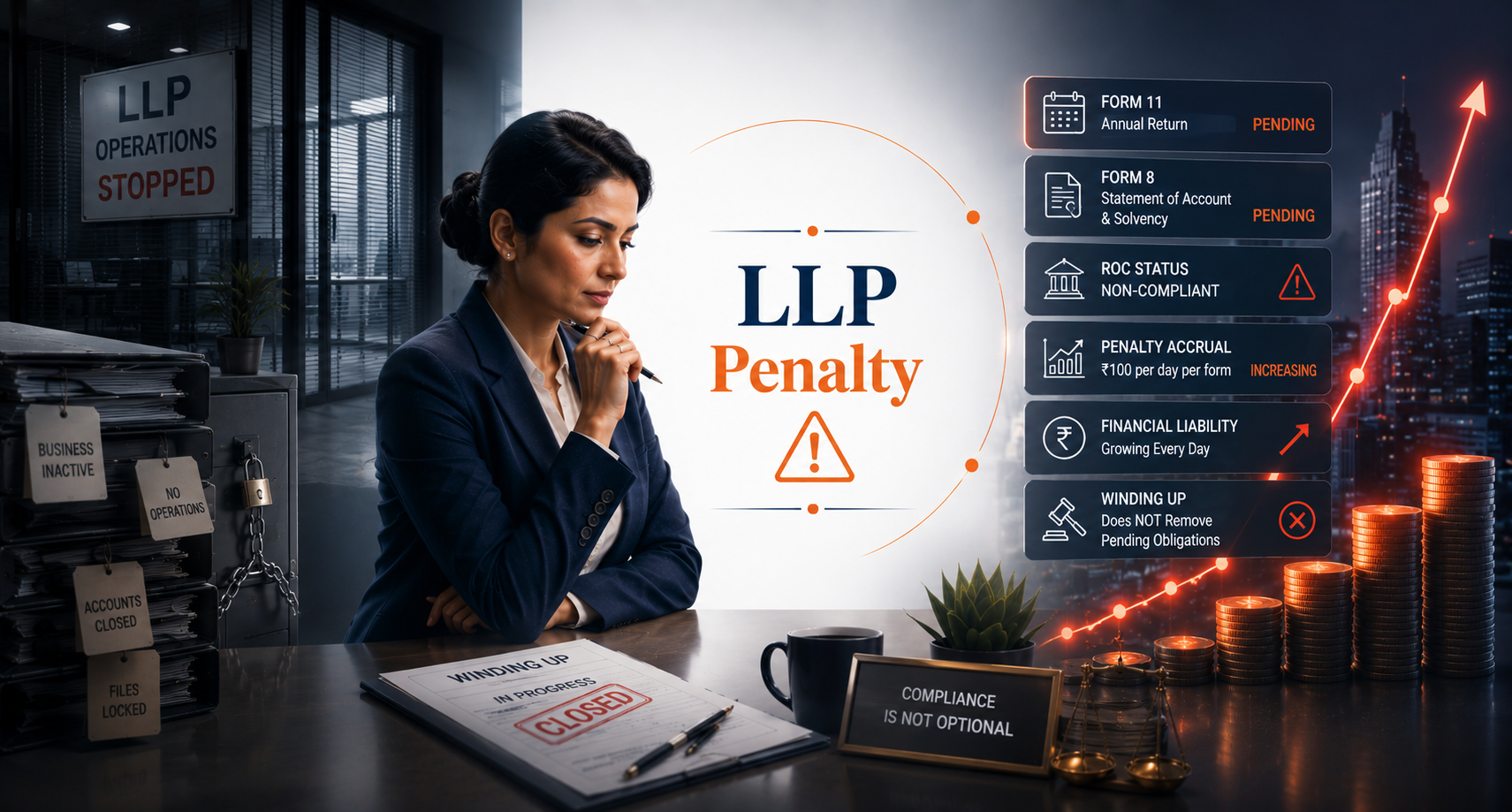
The article you shared correctly highlights the two core annual LLP compliances: Form 11 for the annual return and Form 8 for statement of account and solvency. It also notes that delay in filing attracts a late fee of ₹100 per day per form, and that winding up does not wipe away the obligation to complete pending filings. That is the central compliance reality every LLP partner should understand.
At Acumen Financial Solutions, we help LLPs stay compliant, avoid avoidable penalties, and maintain clean ROC records. Learn more at Acumen Financial Solutions.
Why LLP annual compliance matters
Many LLP owners assume that if the business did not operate, annual filings are not required. That assumption is risky.
Annual filings exist to keep ROC records updated and to ensure the LLP’s legal status remains current. Even a dormant or inactive LLP must continue to file the prescribed forms unless it has gone through the proper closure or strike-off process.
The source content explains this clearly: annual filings remain compulsory even if the business has not commenced, and LLP closure cannot be used as a shortcut to avoid compliance.
That is why compliance should be treated as an ongoing legal responsibility, not a task to revisit only when a problem appears.
Key annual LLP compliances
The main annual filings for an LLP are:
Form 11 – Annual Return
Due date: 30 May of the succeeding financial yearForm 8 – Statement of Account & Solvency
Due date: 30 October of the succeeding financial year
These filings are part of the LLP’s yearly compliance cycle and should be completed even where the LLP had no active business operations.
What happens if LLP annual returns are not filed
Late filing attracts a penalty of ₹100 per day per form, and the penalty begins immediately after the due date until the form is actually filed. The article you shared emphasizes that the fee continues to accumulate and can become substantial if the delay is prolonged.
That means non-filing is not a small issue. A long delay can quickly become expensive, especially if both Form 8 and Form 11 remain pending.
The real impact of late filing can include:
unnecessary financial penalties
ROC non-compliance status
difficulty closing the LLP later
problems in updating MCA records
reputational concerns with lenders, investors, and counterparties
Can winding up save the penalty?
The short answer is no.
The article you shared makes the position very clear: winding up does not eliminate the need to complete pending annual filings. An LLP cannot be properly closed while statutory compliances remain outstanding. The annual filing process and the winding-up process are interconnected, and ROC records must be up to date before closure is completed.
That means if the LLP has old compliance defaults, they normally need to be addressed first. Winding up is not a legal shortcut to erase earlier non-compliance.
Common misunderstanding among LLP partners
A lot of LLP partners believe that if the business has stopped, compliance can also stop. That is not correct.
Even if:
the LLP did not earn revenue
the LLP did not start operations
the LLP remained inactive
the partners want to close it later
annual filing obligations still continue until the LLP is formally closed through the correct legal route.
This is exactly why many businesses later face avoidable late fees and compliance backlogs.
Why timely compliance is the smarter approach
Timely filing is always cheaper and safer than reacting later.
When LLP filings are done on time, the business benefits from:
cleaner ROC records
lower compliance risk
easier closure or conversion later
better legal credibility
reduced penalty exposure
The cost of delay is often far higher than the cost of filing on time.
How Acumen Financial Solutions helps LLPs
At Acumen Financial Solutions, we help LLPs:
review pending ROC obligations
prepare Form 8 and Form 11 filings
organize supporting records
clear old compliance backlogs
avoid accumulating penalties
understand the right closure path if the business is no longer active
Our support is practical, structured, and designed to help businesses stay ahead of compliance issues rather than reacting after penalties have already built up.
Explore more at Acumen Financial Solutions.
Frequently Asked Questions
Is annual filing compulsory for an LLP if it has not started business?
Yes. Annual filings are compulsory even if the LLP has not commenced business or had no transactions during the year.
What are the main annual LLP forms?
The main annual LLP filings are Form 8 and Form 11.
What is the due date for Form 11?
Form 11 is generally due by 30 May of the succeeding financial year.
What is the due date for Form 8?
Form 8 is generally due by 30 October of the succeeding financial year.
What is the penalty for late filing of LLP annual returns?
Late filing attracts ₹100 per day per form from the due date until the form is actually filed.
Can an LLP be wound up without filing pending annual returns?
No. Pending annual filings must be completed before closure or winding up is properly completed.
Does closure remove old compliance penalties?
No. Winding up is not a shortcut to escape penalties already attracted for non-filing.
Final note
For LLPs, compliance is not optional. Form 8 and Form 11 are core annual responsibilities, and delay can quickly create financial and legal pressure. If an LLP is inactive or is being considered for closure, the pending filings still need attention first.
At Acumen Financial Solutions, we help businesses manage LLP compliance with clarity, discipline, and practical support.
Learn more at Acumen Financial Solutions.