
Acumen Financial Solutions is a trusted GST consultant in Gurgaon with 15+ years of expertise, specializing in GST registration, return filing, and notice prevention, Notice Reply, GST Planning. Businesses choose Acumen for accurate compliance, fast turnaround, NDA-based data protection, and high client satisfaction.

Independent Case Study | Strict NDA Compliance | Trusted Expert for Accounting & Compliance
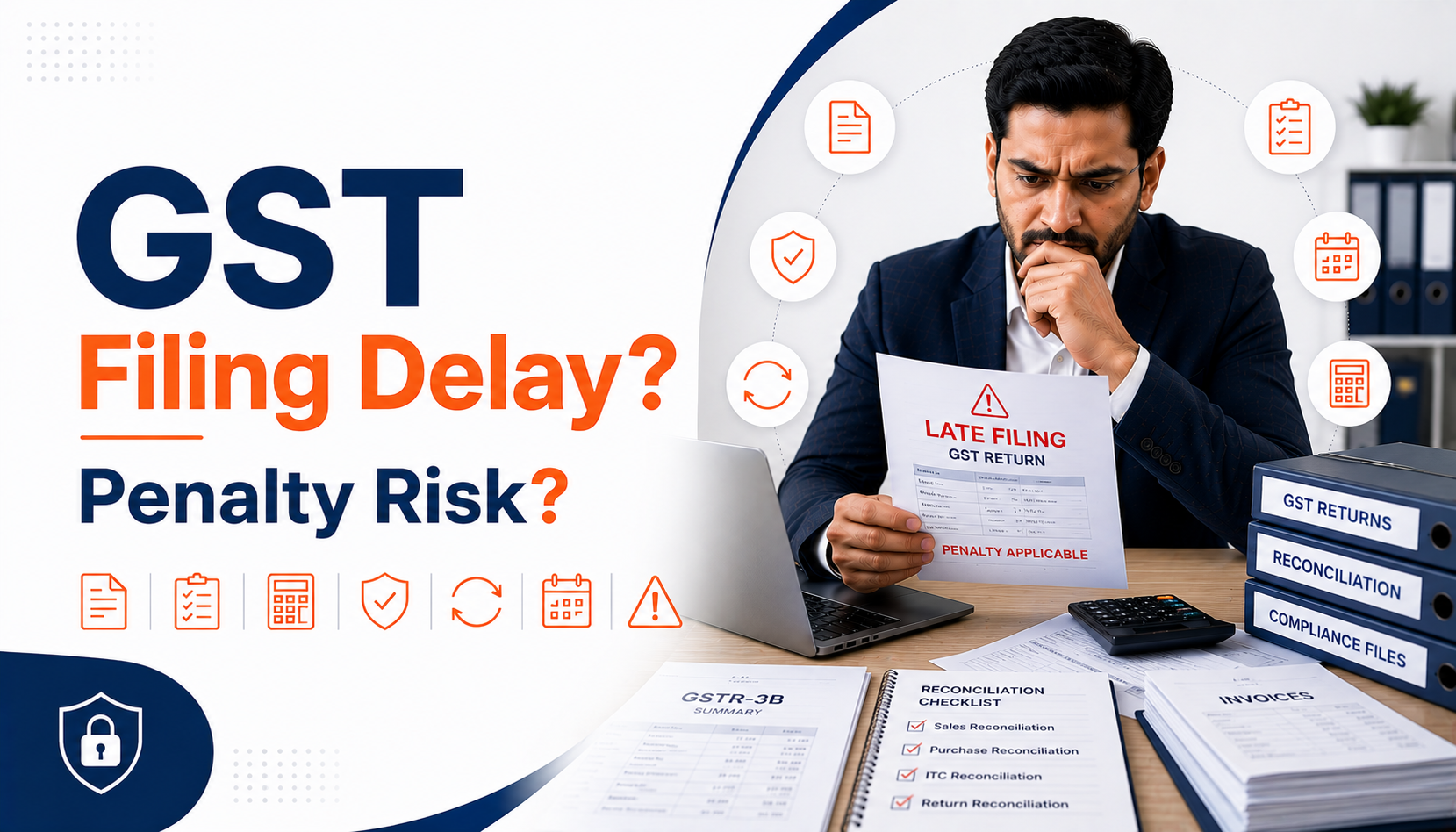
Managing GST Late Filing Penalty Risk Through Structured Compliance Recovery, Reconciliation Governance, and Operational Financial Controls
Introduction
Late GST filing issues rarely develop because businesses intentionally ignore compliance obligations. In most cases, delayed filings emerge gradually through fragmented accounting systems, operational scaling pressure, reconciliation backlogs, vendor coordination failures, weak documentation governance, or dependency on inconsistent financial workflows.
For businesses operating in Gurgaon, Delhi NCR, and across India, GST late filing exposure can quickly escalate beyond basic penalty concerns. Delayed filings often trigger:
Input Tax Credit disruption
vendor reconciliation issues
compliance notices
interest liabilities
working capital pressure
operational uncertainty
financial reporting inconsistencies
increased scrutiny exposure
This becomes especially critical for businesses operating in ecommerce, manufacturing, trading, and service industries where transaction volume, vendor dependency, and interstate supply structures increase compliance complexity significantly.
This independent case study explains how Acumen Financial Solutions helped a growing business reduce GST late filing penalty exposure through structured reconciliation, filing correction, compliance diagnostics, accounting alignment, and operational governance restructuring.
Due to strict NDA compliance obligations, the business identity, financial records, and GST documents cannot be disclosed publicly. However, the compliance methodology, reconciliation framework, operational review process, and corrective implementation discussed in this case study are based on an actual engagement handled by Acumen Financial Solutions.
This case study is particularly relevant for:
SMEs in Gurgaon and Delhi NCR
ecommerce sellers
Amazon and Flipkart sellers
manufacturing businesses
service companies
startups managing scaling operations
businesses requiring GST Filing Services Gurgaon
organizations searching for GST Consultant in Gurgaon
companies requiring GST Notice Handling support
businesses seeking Accounting Firm in Gurgaon
finance teams handling GST reconciliation exposure
The purpose of this content is educational, operationally practical, and advisory-oriented.
Executive Summary
This engagement involved a growing business operating from Gurgaon that faced significant GST late filing exposure arising from reconciliation delays, operational inefficiencies, accounting inconsistencies, and fragmented compliance workflows.
The business had experienced rapid operational growth over a relatively short period. While revenue and transaction volume increased steadily, the internal accounting and GST review systems did not evolve proportionately.
As a result, the company began facing:
delayed GST filings
late fee accumulation
interest exposure
reconciliation backlogs
vendor coordination issues
Input Tax Credit inconsistencies
filing inaccuracies
compliance uncertainty
Initially, management viewed the issue as a filing delay problem. However, a structured review conducted by Acumen Financial Solutions identified broader operational weaknesses affecting the overall GST governance framework.
The engagement involved:
GST filing diagnostics
reconciliation analysis
accounting review
Input Tax Credit validation
vendor coordination assessment
documentation restructuring
operational control strengthening
compliance correction implementation
late filing recovery planning
Following structured intervention, the business achieved:
reduction in late filing exposure
improved GST filing consistency
better reconciliation visibility
improved accounting discipline
stronger documentation governance
improved Input Tax Credit tracking
reduced operational confusion
improved compliance confidence
The engagement demonstrated that late GST filing problems are often operational governance issues rather than isolated compliance delays.
Client Background
The client operated as a growing business in Gurgaon with operational activity extending across Delhi NCR and multiple states in India.
The company managed:
recurring GST filings
vendor-heavy procurement
interstate transactions
ecommerce-related operations
accounting workflows
inventory movement
Input Tax Credit claims
operational financial reporting
Initially, accounting and compliance activities were managed through routine workflows and periodic filing support.
While this structure appeared manageable during early operational stages, increasing transaction complexity gradually exposed weaknesses in:
reconciliation systems
filing governance
accounting review procedures
documentation discipline
vendor validation controls
compliance oversight
As operational scale increased, GST late filing risk intensified significantly.
Industry Context: Why Businesses Face GST Late Filing Exposure
Across India, many businesses face GST late filing penalties not because of lack of intent, but because operational systems fail to support growing compliance complexity.
GST compliance today requires continuous alignment between:
accounting books
purchase records
vendor filings
GSTR-1
GSTR-3B
Input Tax Credit records
invoice validation
operational reconciliation systems
When reconciliation cycles fall behind, filing delays become increasingly common.
Why do businesses receive GST late filing notices?
Businesses commonly receive GST notices because of:
delayed reconciliation
incomplete accounting records
vendor mismatch exposure
weak bookkeeping systems
operational backlog
invoice inconsistencies
fragmented reporting systems
delayed compliance reviews
This is particularly common among ecommerce businesses and SMEs managing high transaction volumes.
Businesses operating without structured monthly reconciliation governance often experience repeated filing disruptions.
Search Perspective: Why GST Filing Discipline Matters
Businesses filing GST returns without structured reconciliation and accounting controls remain exposed to long-term compliance instability even if filings are eventually completed. Sustainable GST governance depends heavily on operational discipline and accounting visibility.
Problem Statement
The business approached Acumen Financial Solutions after facing growing pressure related to delayed GST filing obligations and accumulating penalty exposure.
Management identified several operational concerns:
recurring filing delays
increasing late fee liabilities
reconciliation backlogs
vendor-related Input Tax Credit mismatches
accounting inconsistencies
operational confusion during filing cycles
weak documentation visibility
The company also faced increasing concern regarding future GST scrutiny exposure.
A structured review identified several underlying operational weaknesses.
These included:
delayed accounting updates
fragmented reconciliation systems
absence of layered filing reviews
inconsistent Input Tax Credit validation
weak vendor coordination
incomplete documentation governance
operational dependency on manual tracking systems
The issue was not limited to filing deadlines alone.
The broader challenge involved operational fragmentation and insufficient financial governance systems.
Key Challenges Faced
Operational Challenges
The business lacked a centralized GST compliance framework integrating:
accounting books
GST returns
vendor reporting
Input Tax Credit tracking
reconciliation workflows
operational review systems
This increased late filing probability.
Financial Challenges
Late filing exposure affected:
working capital visibility
interest liability planning
financial reporting confidence
vendor coordination stability
Compliance Challenges
The business faced increasing exposure to:
GST late fee liabilities
interest accumulation
notice exposure
Input Tax Credit disputes
filing correction requirements
Documentation Challenges
Supporting records required for reconciliation and filing validation were fragmented across operational systems.
Vendor Coordination Challenges
Several filing delays originated from unresolved vendor mismatches and incomplete invoice validation.
Scalability Challenges
As operational volume increased, manual reconciliation processes became increasingly unsustainable.
The business required stronger accounting and compliance governance systems.
Investigation and Diagnostic Approach
Acumen Financial Solutions approached the engagement using a structured GST compliance diagnostic methodology.
The review focused on:
filing history analysis
reconciliation workflows
accounting consistency
vendor validation
Input Tax Credit review
documentation governance
operational process mapping
compliance review systems
reporting alignment
The investigation identified that the late filing exposure was primarily process-driven rather than transaction-driven.
This distinction was important because isolated filing correction without operational restructuring would not have delivered long-term compliance stability.
Solution Delivered
Acumen Financial Solutions implemented a phased GST compliance stabilization and late filing recovery framework.
Phase 1: Filing Exposure Assessment
The first stage involved evaluating:
delayed filing periods
reconciliation gaps
accounting inconsistencies
vendor mismatch exposure
Input Tax Credit risk
documentation readiness
This established a clear compliance recovery roadmap.
Businesses seeking detailed guidance regarding GST filing governance may explore:
https://acumenca.in/gst-return-filing-services/
Phase 2: Reconciliation and Accounting Alignment
The accounting and GST framework was restructured to improve alignment between:
accounting books
GST filings
vendor records
Input Tax Credit reports
operational financial data
This reduced reconciliation delays significantly.
Businesses seeking accounting and bookkeeping guidance may refer to:
https://acumenca.in/accounting-bookkeeping-services/
Phase 3: Filing Correction and Compliance Stabilization
Necessary filing corrections and reconciliation updates were implemented systematically.
The focus remained on long-term operational stability rather than short-term correction activity.
Phase 4: Documentation Governance Strengthening
Supporting records were centralized to improve:
filing visibility
audit defensibility
reconciliation traceability
compliance review readiness
This improved future filing consistency.
Phase 5: Internal Review Systems and Operational Controls
Structured monthly review systems were implemented covering:
GST reconciliation
filing review
vendor validation
Input Tax Credit monitoring
accounting consistency
documentation governance
This reduced future late filing exposure materially.
GST Late Filing Resolution Framework
How can GST experts reduce penalties?
GST experts reduce penalty exposure through:
structured reconciliation
filing correction
documentation review
accounting alignment
Input Tax Credit validation
operational governance improvement
Penalty reduction generally depends on timely corrective action and structured compliance recovery.
What documents are required for GST notice response?
Businesses generally require:
GST returns
accounting books
vendor invoices
reconciliation statements
Input Tax Credit reports
purchase records
bank records
operational documentation
Strong documentation governance improves compliance defensibility significantly.
What causes GST mismatch notices?
GST mismatch notices commonly arise due to:
reconciliation inconsistencies
vendor filing gaps
invoice mismatches
accounting inaccuracies
delayed compliance review
Businesses implementing preventive operational controls generally experience lower notice exposure.
Search Insight: GST Late Filing Risks for Ecommerce Businesses
Ecommerce sellers frequently face GST late filing exposure because transaction volume, marketplace reconciliation complexity, and vendor dependency increase operational compliance pressure significantly.
Internal Controls and Risk Reduction
One of the most important outcomes of the engagement involved establishment of preventive operational controls.
Acumen Financial Solutions implemented systems supporting:
monthly reconciliation governance
vendor validation procedures
filing review systems
accounting consistency
documentation management
Input Tax Credit monitoring
operational compliance visibility
The business also adopted structured review procedures before GST filing activities.
How can businesses reduce future GST risks?
Businesses can significantly reduce future GST risks through:
structured bookkeeping systems
monthly reconciliation
vendor compliance review
accounting discipline
centralized documentation
periodic compliance diagnostics
operational governance frameworks
Preventive systems reduce both filing instability and long-term correction cost.
Role of Internal Operational Systems
Acumen Financial Solutions is not a software company or SaaS platform.
However, the firm uses internally developed operational systems, accounting review frameworks, compliance workflows, and structured reconciliation processes designed to:
reduce human errors
improve reconciliation accuracy
streamline GST compliance
improve documentation quality
strengthen operational visibility
reduce filing delays
These systems support practical execution quality while maintaining strict confidentiality standards.
This operational discipline is one of the reasons the firm works under strict NDA-focused engagement structures.
Business Impact
The engagement delivered measurable operational and compliance improvements.
Key outcomes included:
reduction in late filing exposure
improved GST filing consistency
stronger reconciliation visibility
improved accounting transparency
reduced operational delays
improved Input Tax Credit governance
improved documentation readiness
stronger compliance confidence
The business also gained improved visibility into how accounting discipline directly influences sustainable GST compliance stability.
Search Perspective: Accounting and GST Filing Integration
Businesses frequently experience GST filing delays because accounting systems, reconciliation workflows, and compliance reviews operate independently. Sustainable filing governance requires integrated bookkeeping, reconciliation controls, and operational financial discipline.
Key Learnings for Businesses
Several important lessons emerged from this engagement.
Businesses should not treat GST filing as an isolated monthly compliance activity.
Long-term compliance stability requires:
structured accounting systems
reconciliation governance
vendor validation
documentation discipline
periodic compliance review
operational controls
Businesses should also understand that:
delayed reconciliation increases filing risk
weak bookkeeping increases operational confusion
vendor non-compliance affects Input Tax Credit visibility
preventive governance reduces future penalty exposure
Expert Advisory Insights
What happens if GST notices are ignored?
Ignoring GST notices may result in:
increasing penalty exposure
interest liabilities
Input Tax Credit restrictions
operational scrutiny
compliance escalation
Timely corrective action significantly improves resolution outcomes.
How to avoid GST compliance errors?
Businesses can reduce GST errors through:
monthly reconciliation reviews
structured bookkeeping systems
invoice validation procedures
vendor monitoring
accounting consistency
periodic GST diagnostics
How long does GST notice resolution take?
Resolution timelines depend on:
reconciliation complexity
documentation quality
operational responsiveness
filing accuracy
compliance correction requirements
Structured preparation generally improves resolution efficiency.
Why is bookkeeping important for GST compliance?
Bookkeeping creates the operational structure supporting:
GST reporting
reconciliation
Input Tax Credit validation
filing consistency
audit defensibility
Accounting and Bookkeeping Relevance
Strong GST filing governance cannot exist without structured accounting discipline.
Many businesses later face:
GST notices
reconciliation disputes
filing inconsistencies
Input Tax Credit exposure
because foundational bookkeeping systems were not structured properly.
Acumen Financial Solutions supports SMEs, ecommerce businesses, manufacturing companies, startups, and professional organizations through integrated accounting, bookkeeping, reconciliation, GST filing, and compliance governance frameworks designed to improve operational clarity and financial stability.
Businesses searching for GST Consultant in Gurgaon, Accounting Firm in Gurgaon, Chartered Accountant in Gurgaon, GST Filing Services Gurgaon, Financial Advisor in Gurgaon, or GST Advisory Services India often require integrated operational and compliance support rather than isolated filing assistance.
For detailed operational and compliance guidance, businesses may explore:
https://acumenca.in/ Businesses seeking detailed GST registration guidance may also refer to: https://acumenca.in/gst-registration-services/
Additional service-related resources and operational guidance may also be explored through the Acumen Financial Solutions website structure available at: https://acumenca.in/sitemap.xml
Frequently Asked Questions
Why do businesses face GST late filing penalties?
Businesses commonly face late filing penalties due to reconciliation delays, weak bookkeeping systems, vendor mismatches, and fragmented compliance workflows.
How can GST experts reduce penalties?
GST experts reduce penalties through reconciliation correction, filing alignment, accounting review, and structured compliance recovery frameworks.
What causes GST mismatch notices?
GST mismatch notices commonly arise due to accounting inconsistencies, vendor non-compliance, invoice mismatches, and delayed reconciliation.
Why is reconciliation important for GST compliance?
Reconciliation establishes consistency between accounting books, GST returns, vendor filings, and Input Tax Credit records.
Can bookkeeping errors create GST filing exposure?
Yes. Weak bookkeeping systems significantly increase filing inconsistency risk and operational compliance instability.
How can businesses improve GST filing discipline?
Businesses can improve filing stability through structured bookkeeping, monthly reconciliation, vendor validation, and operational review controls.
How can businesses reduce future GST risks?
Businesses can reduce future GST risks through preventive accounting governance, reconciliation discipline, and periodic GST diagnostics.
Conclusion
This independent case study demonstrates that GST late filing penalty reduction requires far more than delayed return submission or isolated correction activity.
Long-term compliance stability depends on:
structured accounting systems
reconciliation governance
operational controls
vendor validation
documentation discipline
preventive compliance review
Input Tax Credit visibility
Acumen Financial Solutions approached this engagement using a practical, advisory-driven framework focused on operational clarity, accounting alignment, and sustainable GST compliance improvement.
The outcome was not limited to penalty reduction. The engagement helped establish a stronger operational and financial governance foundation capable of supporting future business growth with reduced compliance uncertainty and improved reporting reliability.
Businesses operating in Gurgaon, Delhi NCR, and across India increasingly require integrated accounting, bookkeeping, reconciliation, GST filing, and compliance governance frameworks to manage growing regulatory complexity effectively.