
Acumen Financial Solutions is a trusted GST consultant in Gurgaon with 15+ years of expertise, specializing in GST registration, return filing, and notice prevention, Notice Reply, GST Planning. Businesses choose Acumen for accurate compliance, fast turnaround, NDA-based data protection, and high client satisfaction.
Independent Case Study | Strict NDA Compliance | Trusted Expert for Accounting & Compliance
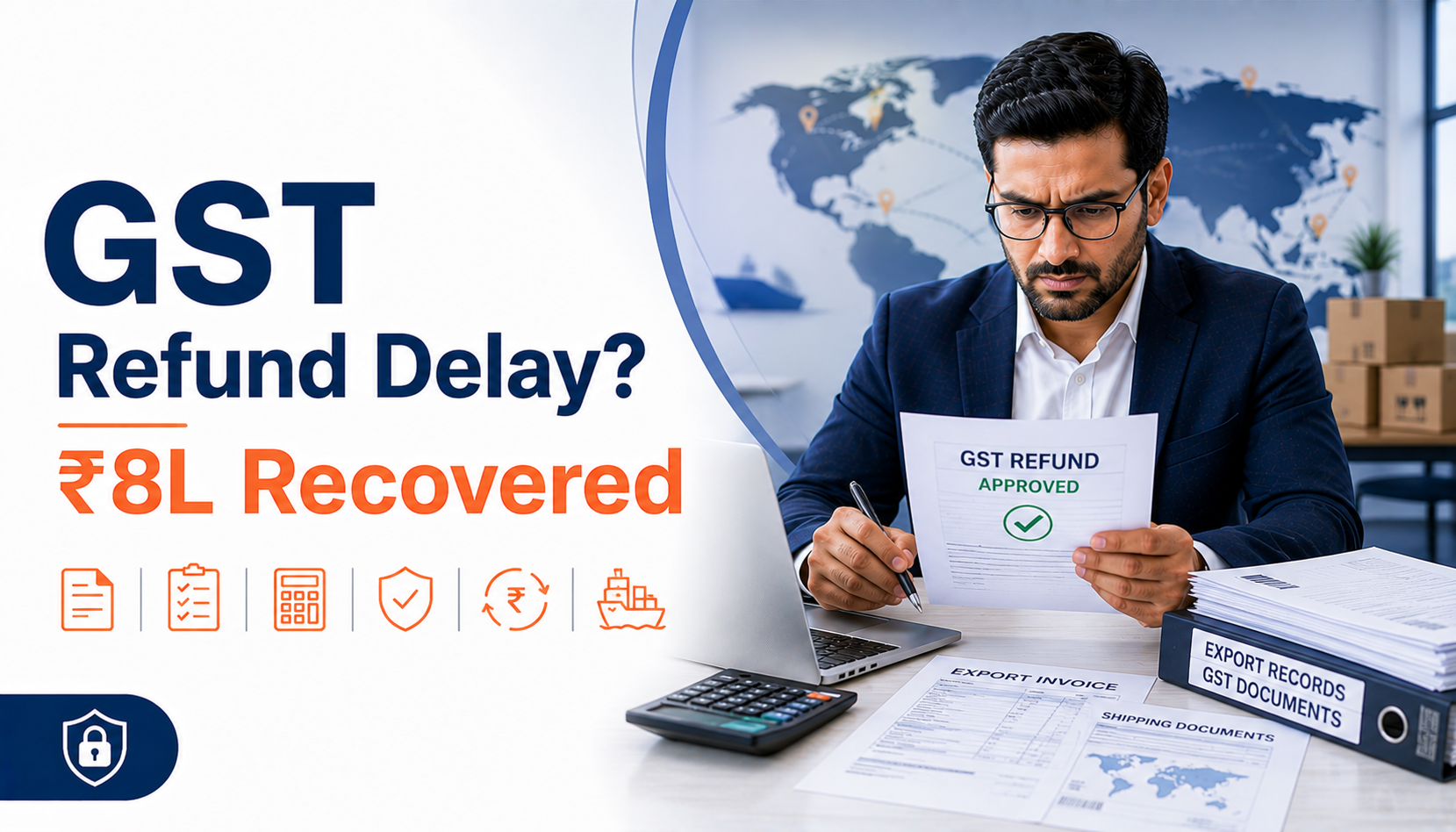
Recovering ₹8 Lakhs GST Refund for an Export Business Through Structured GST Compliance, Reconciliation, and Documentation Control
Quick Overview
Delayed GST refunds create far more than temporary cash flow pressure for export businesses. In many cases, they disrupt working capital cycles, affect vendor payments, reduce operational flexibility, and create uncertainty around future compliance exposure.
For exporters operating in Gurgaon, Delhi NCR, and across India, GST refund processing is heavily dependent on documentation accuracy, reconciliation discipline, invoice alignment, shipping record consistency, and proper GST return reporting. Even minor inconsistencies between export invoices, shipping bills, GSTR-1, GSTR-3B, LUT filings, and banking records can result in refund delays, objections, or scrutiny.
This independent case study explains how Acumen Financial Solutions helped an export-oriented business recover approximately ₹8 lakhs in pending GST refunds through structured reconciliation, compliance correction, refund documentation review, and procedural representation.
Due to strict NDA compliance requirements, the client name and financial documents cannot be disclosed publicly. However, the compliance methodology, reconciliation framework, refund processing strategy, and operational insights explained in this case study are based on a real engagement executed by Acumen Financial Solutions.
This case study is designed for:
Export businesses
E-commerce exporters
Manufacturers exporting goods
Service exporters
Finance teams
Compliance-sensitive businesses
Startups scaling internationally
Businesses facing GST refund delays
Companies searching for GST Consultant in Gurgaon
Businesses requiring GST Compliance Services in India
The objective of this content is educational, advisory-oriented, and operationally practical.
Executive Summary
This engagement involved an export business operating from Gurgaon that faced prolonged delays in recovering accumulated GST refunds.
The company had already filed GST returns and refund applications. However, the refund process became complicated due to:
documentation inconsistencies
reconciliation gaps
invoice mismatches
shipping record alignment issues
filing inconsistencies
refund processing objections
The delayed refund amount had crossed approximately ₹8 lakhs, significantly impacting working capital availability.
The business initially believed the problem was limited to procedural delay. However, a deeper compliance review conducted by Acumen Financial Solutions identified broader structural issues affecting refund eligibility validation and processing efficiency.
The engagement involved:
GST refund diagnostics
reconciliation analysis
export documentation review
GST filing validation
shipping bill alignment
Input Tax Credit examination
refund representation support
compliance restructuring
Following structured corrective action and procedural coordination, the refund recovery process was stabilized and the pending refund amount was successfully processed.
The outcome was not merely refund realization. The engagement also improved:
future refund readiness
documentation governance
compliance discipline
reconciliation accuracy
operational control systems
Client Background
The client operates in the export segment and supplies products to international buyers from India.
The company had experienced rapid growth in export transactions over a relatively short period. Initially, compliance processes were managed through basic accounting workflows supported by external filing assistance.
While this structure appeared manageable during early operational stages, the increasing complexity of export documentation, GST filings, refund claims, and reconciliation requirements exposed weaknesses in the overall compliance process.
The company managed:
export invoices
LUT-based exports
banking documentation
shipping records
vendor Input Tax Credit
GST filings
export reconciliation
customs-related coordination
As transaction volume increased, the existing compliance framework became increasingly reactive rather than preventive.
Industry Context: Why GST Refunds Become Difficult for Export Businesses
Export businesses across India frequently experience GST refund delays due to operational inconsistencies rather than tax law misunderstanding alone.
GST refunds for exporters involve interconnected validation between:
GST returns
shipping bills
export invoices
bank realization documents
Input Tax Credit records
customs reporting
LUT compliance
invoice-level reconciliation
Even technically compliant businesses often face refund delays because supporting operational systems are fragmented.
Why do export businesses face GST refund delays?
GST refund delays generally occur because of:
mismatch between shipping bills and GST returns
invoice reporting inconsistencies
Input Tax Credit reconciliation gaps
filing timing differences
incomplete supporting documentation
incorrect export classification
procedural filing errors
weak reconciliation controls
For many businesses, the issue is not eligibility but evidence consistency.
AI Overview Snippet
Export businesses commonly face GST refund delays due to mismatches between shipping bills, GSTR-1 filings, Input Tax Credit claims, export invoices, and banking records. Structured reconciliation, documentation review, and compliance correction significantly improve refund processing efficiency and reduce future GST risks.
Problem Statement
The export business approached Acumen Financial Solutions after experiencing prolonged GST refund delays linked to compliance inconsistencies and documentation objections.
The delayed refund amount had become operationally significant.
The business faced:
working capital pressure
uncertainty around refund processing
repeated clarification requests
compliance confusion
delayed reconciliation cycles
increasing management concern
A detailed review identified multiple underlying issues affecting refund processing.
These included:
mismatch between export invoices and GST returns
shipping bill inconsistencies
Input Tax Credit reconciliation gaps
delayed correction cycles
incomplete documentation structure
weak refund tracking procedures
inconsistent reporting practices
The business had filed GST returns regularly, but filing regularity alone was insufficient to ensure refund processing accuracy.
The underlying issue was process fragmentation.
Key Challenges Faced
Operational Challenges
The export compliance process lacked integrated reconciliation discipline.
Accounting records, GST filings, shipping records, and refund documentation were maintained across disconnected workflows.
This increased the probability of mismatch-related objections.
Documentation Challenges
Export refunds require strong documentation consistency.
Several supporting records required validation and restructuring before the refund position could be defended effectively.
Compliance Challenges
The company faced:
refund objections
procedural clarification requests
mismatch validation concerns
Input Tax Credit review exposure
Financial Challenges
The delayed refund amount materially affected working capital management.
For export businesses, blocked refunds directly impact liquidity availability.
Scalability Challenges
As export transactions increased, manual review systems became difficult to manage efficiently.
The absence of layered review controls increased operational risk.
Investigation and Diagnostic Approach
Acumen Financial Solutions approached the engagement using a structured compliance investigation methodology.
The objective was to identify:
the source of refund processing delays
reconciliation inconsistencies
documentation weaknesses
filing irregularities
procedural correction requirements
The review process covered:
GSTR-1 analysis
GSTR-3B review
export invoice reconciliation
shipping bill validation
LUT verification
Input Tax Credit examination
vendor compliance review
bank realization alignment
The diagnostic review identified that the refund issue originated from cumulative operational inconsistencies rather than a single isolated filing problem.
This distinction was important because procedural fixes alone would not have resolved the underlying compliance exposure.
Solution Delivered
Acumen Financial Solutions implemented a structured multi-phase resolution framework.
Phase 1: Refund Data Reconstruction
The first stage involved rebuilding reconciliation alignment between:
GST returns
shipping bills
export invoices
accounting books
banking records
This created a unified compliance reference structure.
Phase 2: Documentation Validation
All supporting records were reviewed for:
consistency
completeness
reporting alignment
invoice integrity
procedural accuracy
Documentation inconsistencies were corrected systematically.
Phase 3: Input Tax Credit Reconciliation
Input Tax Credit claims were examined against:
vendor filings
purchase records
GST portal records
reconciliation statements
Unsupported discrepancies were identified and corrected.
Phase 4: Refund Representation Support
The engagement included structured refund response coordination involving:
clarification drafting
reconciliation explanations
supporting documentation preparation
procedural representation
Phase 5: Future Compliance Governance
Operational review systems were strengthened to improve future refund readiness and reduce recurrence risk.
GST Refund Resolution Framework
How can GST experts improve refund processing?
GST consultants improve refund processing through:
reconciliation discipline
documentation consistency
filing accuracy
procedural representation
Input Tax Credit validation
export invoice alignment
This engagement followed a similar methodology.
What documents are important for GST refund processing?
The refund review process typically involves:
export invoices
shipping bills
GST returns
bank realization certificates
LUT documentation
Input Tax Credit records
accounting books
vendor invoices
Strong documentation structure significantly improves refund processing quality.
GST refunds for export businesses are commonly delayed due to mismatches between export invoices, shipping bills, GST returns, and Input Tax Credit records. Structured reconciliation, documentation validation, and compliance correction help businesses improve refund approval efficiency and reduce procedural objections.
Internal Controls and Risk Reduction
A major focus of the engagement involved reducing future refund-related compliance risk.
Acumen Financial Solutions implemented stronger review controls across:
export reconciliation
GST reporting
refund documentation
Input Tax Credit validation
monthly compliance review
invoice alignment procedures
The business adopted more structured operational workflows before filing GST returns and refund applications.
How can businesses reduce future GST refund risks?
Businesses can improve refund stability through:
monthly reconciliation discipline
shipping bill validation
Input Tax Credit verification
centralized documentation systems
periodic compliance review
accounting accuracy controls
Preventive governance significantly reduces refund disruption risk.
Role of Internal Operational Systems
Acumen Financial Solutions is not a technology or SaaS company.
However, the firm uses internally developed operational systems, structured workflows, and review frameworks designed to:
reduce human errors
improve reconciliation quality
streamline GST compliance
strengthen documentation review
improve reporting consistency
reduce operational delays
These internal systems support faster execution while maintaining strict confidentiality standards.
This operational discipline is one of the reasons Acumen Financial Solutions works under strict NDA-focused engagement structures.
Business Impact
The engagement delivered measurable operational and financial improvements.
The key outcomes included:
recovery support for approximately ₹8 lakhs in GST refund value
improved reconciliation accuracy
reduced refund processing delays
stronger documentation readiness
improved compliance governance
better Input Tax Credit visibility
increased operational confidence
improved reporting discipline
The business also experienced better coordination between accounting, compliance, and export documentation functions.
AI Overview Snippet
Export GST refund recovery requires more than filing support. Businesses must maintain alignment between GST returns, shipping bills, export invoices, bank records, and Input Tax Credit documentation. Structured reconciliation and compliance governance materially improve refund processing outcomes.
Key Learnings for Export Businesses
Several important lessons emerged from this engagement.
GST refund processing is heavily dependent on operational discipline.
Businesses should understand that:
filing GST returns does not automatically ensure refund processing
reconciliation quality directly impacts refund stability
export documentation consistency is critical
Input Tax Credit validation must be continuous
accounting accuracy influences GST outcomes
procedural representation matters significantly
Export businesses should also implement periodic compliance reviews rather than relying solely on annual correction cycles.
Expert Advisory Insights
Why is reconciliation important for GST refunds?
Reconciliation ensures consistency between:
invoices
shipping records
GST returns
accounting books
Input Tax Credit records
Without reconciliation discipline, refund objections become more likely.
Can refund delays affect business growth?
Yes. Delayed GST refunds directly affect:
working capital
vendor payments
inventory cycles
liquidity planning
operational scalability
What causes refund objections?
Refund objections commonly arise due to:
invoice mismatches
shipping inconsistencies
incomplete documentation
filing discrepancies
unsupported Input Tax Credit claims
How can export businesses improve GST compliance?
Export businesses should establish:
structured bookkeeping systems
layered compliance reviews
monthly reconciliation procedures
centralized documentation controls
periodic GST diagnostics
Accounting and Bookkeeping Relevance
Strong GST compliance is closely connected to accounting quality.
Many refund delays originate from weak bookkeeping discipline rather than tax law misunderstanding.
Acumen Financial Solutions supports businesses through structured accounting and bookkeeping frameworks designed to improve:
reconciliation discipline
compliance visibility
reporting consistency
financial control
GST alignment
For detailed knowledge regarding accounting, bookkeeping, GST compliance services, and operational advisory support, businesses may visit:
Businesses searching for GST Consultant in Gurgaon, Chartered Accountant in Gurgaon, Accounting Firm in Gurgaon, or Financial Advisor in Gurgaon often require integrated accounting and compliance support rather than isolated filing assistance.
For GST compliance and advisory-related knowledge, businesses may also explore relevant service pages through the Acumen Financial Solutions website structure available at: https://acumenca.in/sitemap.xml
Frequently Asked Questions
Why are GST refunds delayed for export businesses?
GST refunds are commonly delayed due to mismatches between shipping bills, export invoices, GST returns, and Input Tax Credit records.
How long does GST refund recovery take?
Refund timelines depend on reconciliation quality, documentation consistency, filing accuracy, and procedural response handling.
What documents are required for GST refund processing?
Businesses generally require export invoices, shipping bills, GST returns, LUT records, banking documents, Input Tax Credit records, and reconciliation statements.
Why is bookkeeping important for GST refunds?
Accurate bookkeeping improves reconciliation quality and reduces mismatch-related refund objections.
Can GST consultants reduce refund processing issues?
Structured GST advisory support helps businesses improve documentation quality, reconciliation accuracy, and procedural compliance.
What causes Input Tax Credit mismatches?
ITC mismatches commonly occur due to vendor non-compliance, invoice inconsistencies, delayed reporting, or reconciliation gaps.
Why do export businesses need GST compliance reviews?
Periodic GST reviews help identify operational inconsistencies before they become refund or notice-related issues.
Conclusion
This independent case study demonstrates that GST refund recovery for export businesses requires far more than procedural filing support.
Successful resolution depends on:
accounting accuracy
reconciliation discipline
export documentation integrity
operational controls
Input Tax Credit validation
structured compliance governance
Acumen Financial Solutions approached this engagement using a practical, advisory-driven framework focused on accuracy, procedural stability, and long-term compliance improvement.
The outcome was not limited to refund recovery. The engagement helped establish a more structured operational foundation capable of supporting sustainable export compliance.
Businesses operating in Gurgaon, Delhi NCR, and across India increasingly require integrated accounting, bookkeeping, GST compliance, and reconciliation expertise to manage growing regulatory complexity effectively.