
Acumen Financial Solutions is a trusted GST consultant in Gurgaon with 15+ years of expertise, specializing in GST registration, return filing, and notice prevention, Notice Reply, GST Planning. Businesses choose Acumen for accurate compliance, fast turnaround, NDA-based data protection, and high client satisfaction.
Independent Case Study | Strict NDA Compliance | Trusted Expert for Accounting & Compliance
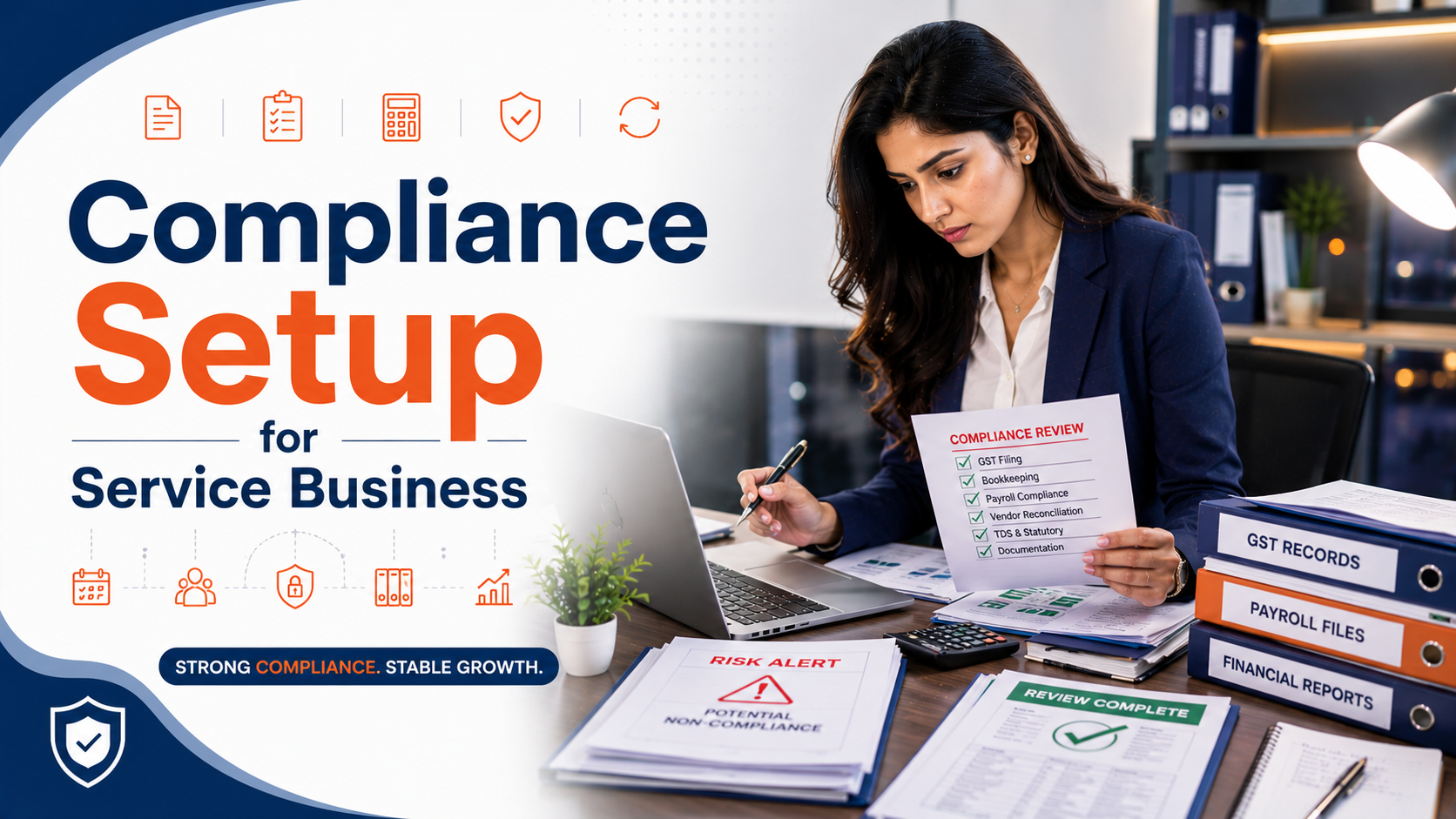
Building a Structured Compliance and Financial Governance Framework for a Growing Service Business Through GST Alignment, Accounting Discipline, and Operational Control Systems
Introduction
Many service businesses in India initially operate with limited compliance structures because founders focus primarily on business development, client acquisition, operational execution, and revenue growth. During the early growth phase, accounting, GST filing, bookkeeping, vendor documentation, payroll governance, and statutory compliance are often managed reactively instead of strategically.
As operational scale increases, this fragmented approach gradually creates serious compliance instability.
Businesses operating in Gurgaon, Delhi NCR, and across India frequently face:
GST filing inconsistencies
Input Tax Credit mismatches
delayed bookkeeping
vendor reconciliation gaps
payroll reporting errors
TDS inconsistencies
notice exposure
accounting transparency issues
operational reporting instability
The situation becomes significantly more complex when service businesses manage:
interstate billing
recurring client invoicing
multiple vendors
employee reimbursement structures
consultant payouts
digital transactions
ecommerce or SaaS-linked service operations
multi-state compliance exposure
Many businesses continue filing GST returns periodically while operational inconsistencies silently accumulate inside accounting systems, documentation workflows, and financial reporting structures.
Eventually, these inconsistencies create:
GSTR-1 mismatch notices
GST scrutiny exposure
Input Tax Credit disputes
accounting reconciliation failures
compliance penalties
financial reporting uncertainty
operational inefficiency
This independent case study explains how Acumen Financial Solutions helped a growing service business in Gurgaon establish a structured compliance framework through accounting stabilization, GST alignment, reconciliation governance, documentation restructuring, and operational financial control systems.
Due to strict NDA compliance obligations, the business name, GST records, financial reports, operational documents, and accounting data cannot be disclosed publicly. However, the methodologies, reconciliation frameworks, governance systems, and compliance processes discussed in this case study are based on an actual engagement handled by Acumen Financial Solutions.
This case study is especially relevant for:
service businesses
startups
consulting firms
digital agencies
operationally scaling SMEs
ecommerce-linked service providers
businesses searching for GST Consultant in Gurgaon
companies requiring GST Filing Services Gurgaon
organizations seeking Accounting Firm in Gurgaon
businesses requiring Chartered Accountant in Gurgaon
companies needing Accounting & Bookkeeping Services Gurgaon
organizations seeking GST Compliance Services India
The purpose of this content is educational, analytical, and operationally practical.
Executive Summary
This engagement involved a rapidly growing service business headquartered in Gurgaon operating across Delhi NCR and multiple Indian states.
The company experienced substantial business growth over a relatively short operational period. However, compliance infrastructure, accounting governance, GST workflows, and operational documentation systems did not scale proportionately with transaction complexity.
The business faced increasing operational concerns involving:
GST filing inconsistencies
Input Tax Credit mismatches
vendor reconciliation instability
delayed bookkeeping
payroll compliance inconsistencies
accounting classification errors
operational reporting gaps
financial visibility concerns
Management initially believed the issue was limited to delayed accounting support. However, a structured compliance review conducted by Acumen Financial Solutions identified broader governance weaknesses affecting the company’s financial stability and long-term compliance defensibility.
The engagement involved:
compliance diagnostics
GST reconciliation review
accounting stabilization
Input Tax Credit validation
bookkeeping restructuring
vendor reconciliation
payroll governance review
documentation standardization
financial reporting alignment
operational control implementation
Following structured intervention, the business achieved:
improved GST filing consistency
reduced reconciliation exposure
improved accounting visibility
stronger documentation governance
reduced operational delays
improved payroll compliance
stronger financial reporting reliability
improved compliance confidence
The engagement demonstrated that sustainable compliance stability depends heavily on accounting discipline, reconciliation governance, operational review systems, and structured documentation frameworks rather than filing activity alone.
Client Background
The client operated as a service-oriented business based in Gurgaon with operational activities extending across Delhi NCR and multiple Indian cities.
The company managed:
service invoicing
recurring GST filings
employee payroll
vendor payments
consultant reimbursements
interstate transactions
digital payments
accounting workflows
monthly compliance activities
Initially, operational reporting and compliance activities were managed through fragmented accounting processes supported by limited internal review structures.
As transaction volume increased, operational complexity expanded involving:
vendor reconciliation
payroll reporting
GST classification
TDS compliance
Input Tax Credit verification
invoice-level consistency
documentation governance
operational reporting synchronization
Over time, the lack of centralized financial governance created increasing compliance instability.
Industry Context: Why Service Businesses Face Compliance Instability
Many service businesses assume compliance risk primarily affects manufacturing companies, exporters, or ecommerce sellers. In practice, service businesses face equally significant compliance exposure because service transactions often involve recurring invoicing, digital payments, consultant structures, vendor-heavy procurement, and complex operational accounting classifications.
Why do service businesses receive GST notices?
Service businesses commonly receive GST notices because accounting books, GST returns, vendor records, and operational documentation often fail to remain synchronized over time.
What causes GST mismatch notices for service companies?
GST mismatch notices commonly arise due to:
incorrect invoice classifications
Input Tax Credit inconsistencies
delayed bookkeeping
vendor filing mismatches
reconciliation gaps
accounting errors
operational reporting inconsistencies
documentation weaknesses
Businesses operating without structured compliance governance systems remain highly vulnerable to scrutiny.
Why do growing startups face compliance problems?
Growing startups frequently experience compliance instability because operational growth outpaces accounting governance and financial review systems.
Search Perspective: Why Compliance Setup Matters for Service Businesses
Service businesses operating in Gurgaon and Delhi NCR increasingly require structured accounting and GST governance because recurring invoicing, vendor coordination, payroll reporting, and Input Tax Credit reconciliation create elevated operational complexity.
Problem Statement
The business approached Acumen Financial Solutions after facing increasing operational and compliance difficulties during rapid business expansion.
Management identified concerns involving:
GST filing inconsistencies
delayed accounting updates
vendor reconciliation instability
payroll reporting concerns
Input Tax Credit discrepancies
bookkeeping delays
operational reporting inconsistencies
documentation weaknesses
The company also faced growing concern regarding:
future GST scrutiny
compliance penalties
financial reporting reliability
operational visibility
audit defensibility
A structured review identified several operational weaknesses.
These included:
fragmented bookkeeping systems
delayed reconciliation processes
weak documentation governance
inconsistent accounting classifications
insufficient layered review controls
vendor reporting inconsistencies
absence of centralized compliance governance
The issue extended beyond GST filing activity.
The broader challenge involved lack of synchronized accounting and operational governance systems.
Key Challenges Faced
Operational Challenges
The business lacked centralized systems integrating:
accounting books
GST filings
payroll reporting
vendor reconciliation
Input Tax Credit validation
operational documentation
financial reporting systems
This significantly increased compliance exposure.
Financial Challenges
Operational inconsistencies affected:
working capital visibility
vendor payment tracking
financial forecasting
management reporting
profitability visibility
Compliance Challenges
The business faced exposure related to:
GST scrutiny notices
Input Tax Credit disputes
filing inconsistencies
TDS reporting gaps
compliance escalation
Documentation Challenges
Supporting records required for operational defensibility remained fragmented across internal systems.
Vendor Coordination Challenges
Vendor-side inconsistencies complicated Input Tax Credit validation and reconciliation processes.
Scalability Challenges
As operational scale increased, manual accounting and reconciliation systems became increasingly ineffective.
The business required structured financial governance.
Investigation and Diagnostic Approach
Acumen Financial Solutions approached the engagement using a structured operational and compliance diagnostic methodology.
The review focused on:
GST filing consistency
bookkeeping review
vendor reconciliation analysis
payroll governance
Input Tax Credit validation
accounting classification consistency
operational documentation review
reporting alignment
reconciliation diagnostics
compliance governance evaluation
The investigation identified that operational instability was largely process-driven rather than transaction-driven.
This distinction was important because isolated filing correction would not have improved long-term compliance defensibility without governance restructuring.
Solution Delivered
Acumen Financial Solutions implemented a phased compliance stabilization framework.
Phase 1: Compliance Exposure Assessment
The first stage involved evaluating:
GST filing inconsistencies
bookkeeping gaps
payroll reporting weaknesses
vendor reconciliation issues
operational reporting inconsistencies
documentation deficiencie
This established a structured compliance governance roadmap.
Businesses seeking GST registration guidance may explore:
https://acumenca.in/gst-registration-services/
Phase 2: Accounting Stabilization and Reconciliation Alignment
The accounting structure was reorganized to improve consistency between:
accounting books
GST filings
vendor records
payroll systems
Input Tax Credit reports
operational documentation
This significantly improved financial transparency.
Businesses seeking detailed accounting and bookkeeping guidance may refer to:
https://acumenca.in/accounting-bookkeeping-services/
Phase 3: GST Compliance Alignment and Documentation Governance
The engagement included:
GST reconciliation review
Input Tax Credit validation
accounting correction
documentation restructuring
filing consistency alignment
operational clarification procedures
This materially reduced compliance exposure.
Businesses seeking GST filing guidance may also explore:
https://acumenca.in/gst-return-filing-services/
Phase 4: Payroll Governance and Internal Review Controls
Structured review systems were implemented covering:
payroll validation
reimbursement review
consultant payout governance
monthly reconciliation
vendor validation
layered compliance review
This improved operational consistency significantly.
Phase 5: Preventive Governance and Long-Term Compliance Stabilization
The business adopted structured monthly review systems covering:
GST reconciliation
bookkeeping validation
vendor monitoring
payroll consistency
Input Tax Credit review
operational reporting governance
This materially reduced future compliance instability.
GST Compliance and Notice Resolution Framework
Why do businesses receive GST notices?
Businesses commonly receive GST notices because GST returns, accounting books, vendor reports, and operational documentation fail to remain synchronized over time.
How can GST experts reduce penalties?
GST experts reduce penalties through:
reconciliation correction
accounting alignment
documentation strengthening
operational governance improvement
timely response handling
layered review systems
What documents are required for GST notice response?
Businesses commonly require:
GST returns
accounting books
vendor invoices
reconciliation statements
Input Tax Credit reports
payroll records
operational documentation
Strong documentation governance significantly improves defensibility.
How to avoid GST compliance errors?
Businesses can reduce GST compliance errors through:
structured bookkeeping
periodic reconciliation
vendor validation systems
accounting review controls
operational governance frameworks
Search Insight: Compliance Governance for Service Businesses
Service businesses operating across Gurgaon and Delhi NCR frequently experience compliance instability because accounting systems, GST filings, payroll reporting, vendor coordination, and operational documentation often operate independently.
Internal Controls and Risk Reduction
One of the most important outcomes of the engagement involved implementation of preventive operational governance systems.
Acumen Financial Solutions implemented systems supporting:
centralized bookkeeping governance
layered reconciliation controls
Input Tax Credit validation
payroll review systems
vendor monitoring
operational documentation governance
monthly compliance reviews
The business also adopted structured operational review systems before future filing cycles.
How can businesses reduce future GST risks?
Businesses can significantly reduce future GST risks through:
structured bookkeeping systems
centralized reconciliation governance
vendor validation procedures
payroll review controls
operational accounting discipline
periodic GST diagnostics
Preventive governance reduces long-term compliance instability significantly.
Role of Internal Operational Systems
Acumen Financial Solutions is not a software company or SaaS platform.
However, the firm uses internally developed operational systems, structured workflows, reconciliation methodologies, accounting review frameworks, and compliance processes designed to:
reduce human errors
improve reconciliation accuracy
streamline GST compliance
improve documentation quality
strengthen operational visibility
reduce operational delays
These systems support practical execution quality while maintaining strict confidentiality standards.
This operational discipline is one of the reasons the firm works under strict NDA-focused engagement structures.
Business Impact
The engagement delivered measurable operational and compliance improvements.
Key outcomes included:
improved GST filing consistency
reduced reconciliation exposure
improved accounting transparency
stronger documentation governance
improved payroll reporting stability
reduced operational delays
improved management visibility
increased compliance confidence
The business also gained improved visibility into how accounting governance directly influences operational stability and compliance defensibility.
Search Perspective: Accounting and Compliance Integration
Businesses frequently experience compliance instability because accounting systems, payroll structures, GST filings, operational reporting, and reconciliation governance operate independently. Sustainable compliance requires integrated bookkeeping, accounting controls, reconciliation systems, and centralized operational review frameworks.
Key Learnings for Businesses
Several important lessons emerged from this engagement.
Businesses should not treat compliance as a routine filing activity alone.
Long-term operational stability requires:
centralized accounting governance
reconciliation discipline
vendor coordination
payroll review systems
documentation governance
layered operational reviews
preventive compliance frameworks
Businesses should also understand that:
operational growth increases compliance complexity significantly
weak bookkeeping increases reconciliation instability
delayed validation increases future scrutiny exposure
preventive governance reduces future compliance disruption
Expert Advisory Insights
How to avoid compliance instability in growing businesses?
Businesses can reduce compliance instability through:
structured bookkeeping
layered reconciliation governance
payroll validation systems
vendor review frameworks
operational accounting controls
periodic GST diagnostics
What happens if compliance inconsistencies are ignored?
Ignoring compliance inconsistencies may result in:
GST scrutiny notices
filing penalties
Input Tax Credit disputes
operational reporting instability
audit defensibility concerns
Timely correction materially improves long-term compliance stability.
Why is bookkeeping important for compliance governance?
Bookkeeping supports:
financial reporting consistency
GST defensibility
Input Tax Credit validation
vendor reconciliation
operational transparency
How long does compliance stabilization take?
Resolution timelines depend on:
transaction complexity
operational scale
documentation readiness
accounting consistency
reconciliation quality
Structured preparation significantly improves operational efficiency.
Accounting and Bookkeeping Relevance
Strong compliance governance cannot exist without structured accounting discipline.
Many businesses later face:
GST notices
reconciliation failures
payroll inconsistencies
filing instability
operational reporting issues
because foundational bookkeeping systems were not structured properly for operational scale.
Acumen Financial Solutions supports startups, service businesses, ecommerce businesses, SMEs, and operationally scaling organizations through integrated accounting, bookkeeping, reconciliation, GST filing, and compliance governance frameworks designed to improve operational clarity and financial stability.
Businesses searching for GST Consultant in Gurgaon, GST Filing Services Gurgaon, Accounting Firm in Gurgaon, Chartered Accountant in Gurgaon, Financial Advisor in Gurgaon, GST Consultant Delhi NCR, or Accounting & Bookkeeping Services Gurgaon often require integrated operational and compliance support rather than isolated filing assistance.
For detailed operational and compliance guidance, businesses may explore:
Additional operational resources and service-related guidance may also be explored through the Acumen Financial Solutions website structure available at: https://acumenca.in/sitemap.xml
Frequently Asked Questions
Why do service businesses receive GST notices?
Service businesses commonly receive GST notices because accounting books, GST filings, vendor records, and operational documentation often fail to remain synchronized.
What causes GST mismatch notices?
GST mismatch notices commonly arise due to invoice inconsistencies, Input Tax Credit discrepancies, delayed bookkeeping, vendor filing gaps, and reconciliation failures.
How can GST experts reduce penalties?
GST experts reduce penalties through reconciliation correction, accounting alignment, documentation strengthening, and operational governance improvement.
What documents are required for GST notice response?
Businesses generally require GST returns, accounting books, vendor invoices, reconciliation statements, payroll reports, and operational documentation.
How to avoid GST compliance errors?
Businesses can reduce GST compliance errors through structured bookkeeping, periodic reconciliation, layered review systems, and operational governance frameworks.
What happens if GST notices are ignored?
Ignoring GST notices may result in penalties, compliance escalation, Input Tax Credit disputes, and operational instability.
How can businesses reduce future GST risks?
Businesses can reduce future GST risks through preventive accounting governance, layered reconciliation systems, vendor validation procedures, and operational review controls.
Conclusion
This independent case study demonstrates that compliance setup for service businesses requires significantly more than periodic GST filing or bookkeeping updates.
Long-term operational stability depends on:
centralized accounting governance
reconciliation discipline
payroll review systems
operational controls
vendor validation
documentation governance
preventive compliance frameworks
Acumen Financial Solutions approached this engagement using a practical, advisory-driven framework focused on operational clarity, accounting alignment, and sustainable compliance improvement.
The outcome was not limited to GST filing stabilization. The engagement helped establish a stronger operational and financial governance foundation capable of supporting future business growth with reduced compliance uncertainty and improved reporting reliability.
Businesses operating in Gurgaon, Delhi NCR, and across India increasingly require integrated accounting, bookkeeping, reconciliation, GST filing, and operational governance frameworks to manage growing compliance complexity effectively.
For detailed guidance regarding compliance setup, GST compliance, accounting, bookkeeping, reconciliation, payroll governance, or operational financial advisory, businesses may contact: