
Benefits of Outsourcing Accounting for Small Businesses in 2026
Small businesses lose time and visibility when accounting stays in-house. Learn how outsourcing improves accuracy, compliance, cash flow, and growth with Acumen Financial Solutions.
ACCOUNTING & BOOKKEEPING
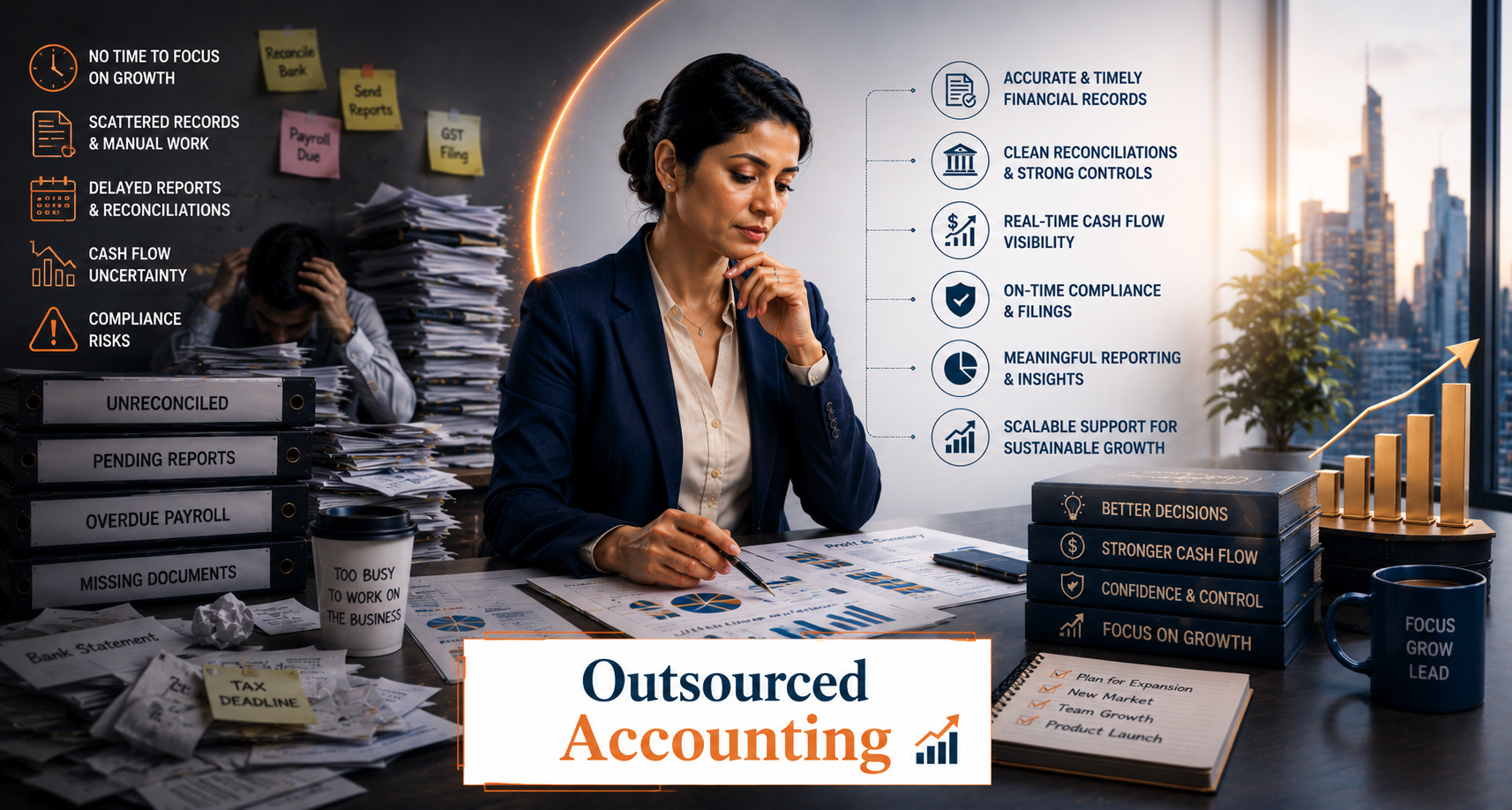
Benefits of Outsourcing Accounting for Small Businesses: A CPA’s Strategic Guide
For many small businesses, accounting becomes expensive for the wrong reasons.
It is not expensive because the work is complex. It is expensive because the work is often done too late, too manually, and with too much pressure on one person or a very small team.
That is the central idea behind outsourcing accounting for small businesses. The reference article you shared makes this point clearly: handling everything in-house is often not feasible, and small businesses today expect faster turnaround, better insights, and competitive pricing while firms deal with staffing pressure and rising overhead.
At Acumen Financial Solutions, we see this every day. Small businesses do not need more accounting noise. They need cleaner books, better visibility, fewer compliance surprises, and a support model that scales with them instead of slowing them down.
What Outsourcing Accounting for Small Businesses Really Means
What is outsourcing accounting for small businesses? It is the practice of moving bookkeeping, accounting, payroll, reconciliation, reporting, compliance, and related finance functions to a specialist team instead of trying to manage everything internally.
That is more than a cost decision. It is an operational decision.
When the accounting function is structured well, the business owner gets back time, the financial records become more reliable, and management can make decisions with current information instead of assumptions. The source article highlights the same broader value: outsourcing is not just about reducing stress; it is about creating a real business impact through expertise, speed, and better financial control.
Why Small Businesses Keep Struggling With In-House Accounting
One of the most common mistakes I see founders make is treating accounting as a background task that can be handled whenever time is available.
In practice, that creates avoidable problems.
When accounting stays too close to the founder or a single overloaded employee, the business tends to experience delayed reconciliations, missed compliance items, poor cash-flow visibility, and reporting that is already outdated by the time management sees it.
The article you shared describes a similar challenge from the CPA-firm side: too much time spent categorizing transactions, reconciling bank statements, and worrying about payroll compliance means too little time spent on growth. That same pattern applies to small businesses themselves.
The business does not just lose hours. It loses clarity.
And when clarity is missing, decision-making becomes reactive.
The Real Business Impact of Outsourcing Accounting
The value of outsourcing accounting for small businesses is not theoretical. The reference article cites real market adoption and notes that many businesses already use external service providers for accounting and bookkeeping functions. It also points to a clear shift after COVID-19, where more small businesses increased reliance on professional outsourcing support.
The business impact usually shows up in four ways.
First, the owner gets more time back.
Instead of spending evenings on spreadsheets, reconciliations, or payroll follow-up, the business can focus on sales, operations, customer service, or product delivery.
Second, the financial records become more dependable.
That matters because clean books are not just for tax season. They affect lending, vendor trust, investor readiness, and the owner’s own confidence in the numbers.
Third, compliance pressure goes down.
A business that is behind on filings, payroll, or reconciliations often pays the price later in penalties, corrections, or rushed reviews.
Fourth, the firm gains access to expertise that may not exist internally.
The article notes that outsourcing gives small businesses direct access to accounting specialists who can handle QuickBooks, Xero, Sage, payroll complexity, and multi-state or multi-jurisdiction requirements.
What Expertise Small Businesses Gain From Outsourcing
What does an outsourced accounting partner actually bring that a small business team may not have?
In my experience working with businesses of different sizes, the most valuable gain is not just execution. It is pattern recognition.
A good outsourced accounting team has already seen the same mistakes many times:
unreconciled bank accounts
inconsistent coding of expenses
payroll issues created by manual processes
GST and tax mismatches
reporting delays caused by missing documents
poor month-end discipline
cash flow blind spots
The reference article emphasizes that outsourcing teams often bring expertise across software, compliance, and reporting, along with AI-driven automation, regulatory knowledge, and support for budgeting and KPI dashboards.
That combination matters because small businesses do not just need records. They need financial intelligence.
How Outsourcing Improves Scalability
Growth is where in-house accounting often breaks down.
A small business may survive with one internal bookkeeper at low volume. But as revenue grows, transactions increase, payroll becomes more complex, and compliance pressure rises. That is when the business starts feeling the strain.
Outsourcing solves this by making accounting capacity flexible.
You can start with monthly bookkeeping.
Then add compliance support.
Then payroll.
Then reporting.
Then more advanced finance support as the business grows.
The source article makes the same point: outsourcing helps businesses scale from basic bookkeeping to full financials as revenue grows, without the staffing cycle that normally comes with hiring temporary or permanent help.
That flexibility is one of the most practical advantages available to a growing company.
Why Security and Compliance Are Still Manageable
A lot of business owners hesitate because of security concerns.
That concern is valid.
Accounting data is sensitive. It includes payroll, banking, client details, tax records, and financial statements. But security concerns do not make outsourcing a bad model. They just make the provider selection more important.
The reference article discusses SOC 2, encryption, NDAs, firewalls, 2FA, and oversight as the safeguards that help make outsourced accounting secure and compliant.
The right question is not “Is outsourcing risky?”
The right question is “Does the provider have the controls, review systems, and confidentiality practices to manage the risk properly?”
At Acumen Financial Solutions, that is exactly where the structure matters. Our onboarding workflows, QC systems, review layers, escalation paths, internal SLAs, standardized reporting, and compliance checklists are designed to create consistency, scalability, and predictable quality.
What Small Businesses Should Outsource First
Not every accounting function needs to move at once.
The smartest approach is usually to begin with the areas that create the most friction or consume the most founder time.
For most businesses, that means:
bookkeeping
monthly accounting
payroll management
compliance filing support
MIS reporting
cash flow statements
cleanup or catch-up work
The reference article also points out that outsourcing can cover the areas where small businesses need immediate relief while still keeping growth-focused work in-house.
If the books are behind, start there.
If payroll is creating stress, start there.
If compliance is causing notices or anxiety, start there.
The point is not to outsource everything blindly. It is to create order where the business needs it most.
Why Acumen Financial Solutions Is a Great Fit
Acumen Financial Solutions is a strong fit for small businesses because our model is built around what owners actually need in real life: personal attention, fast communication, and dependable accounting execution.
We do not work like a generic support center.
Every client gets a dedicated accountant.
That means no support-ticket queue, no repetitive handoffs, and no need to explain the same issue again and again.
We also provide direct access to the senior team, which helps speed up decision-making when something urgent comes up.
Our pricing structure is designed to make premium support accessible:
GST compliance for startups starts from ₹1,000/month
Monthly accounting & compliance starts from ₹6,897 + GST/month
E-commerce accounting starts from ₹10,000/month
Franchise accounting starts from ₹10,000/month
We currently support 1,000+ satisfied clients across startups, SMEs, and larger enterprises, including a company with ₹800 Crore+ annual turnover. That kind of scale has helped us build practical systems, not just service descriptions.
For businesses that want consistent reporting, weekly and monthly MIS, cash flow statements, direct senior communication, and a team that takes responsibility instead of passing work around, Acumen Financial Solutions is built for that model. Learn more at https://acumenca.in.
Frequently Asked Questions
How much can small businesses save with outsourcing accounting?
Savings vary based on the size of the business, the complexity of the books, and the extent of work being outsourced. The reference article notes that outsourcing can reduce fixed salary and overhead costs and may create meaningful annual savings by replacing full-time internal costs with flexible service pricing. In many cases, the real value is not only cost reduction but also the time and risk saved through better accuracy and more consistent financial oversight.
Is data safe when outsourcing accounting for small businesses?
Yes, if the provider has proper security controls. The article specifically mentions SOC 2 compliance, bank-level encryption, NDAs, firewalls, two-factor authentication, and US-based oversight as the kinds of safeguards businesses should expect from a serious outsourcing partner. Security is manageable when processes are documented and access is controlled.
What services come with outsourcing accounting for small businesses?
Common outsourced accounting services include bookkeeping, bank reconciliation, payroll, compliance filing, tax prep support, reporting, budgeting assistance, and KPI dashboard support. The source article also notes that providers can bring expertise in QuickBooks, Xero, Sage, payroll complexities, and regulatory updates.
How quickly can I start outsourcing accounting?
That depends on how organized the current books are and how quickly the provider can complete onboarding. If the scope is clear, documents are available, and the systems are straightforward, a business can often begin with one function such as bookkeeping or payroll and expand from there. The key is to start early enough to allow setup, review, and process alignment.
Can outsourcing help if my accounting is already behind?
Yes. Catch-up work and cleanup work are often where outsourcing creates the fastest relief. If the books are messy, overdue, or inconsistent, an external team can help restore order, rebuild reporting, and create a cleaner monthly routine going forward.
What kind of businesses benefit most from outsourcing accounting?
Small businesses with limited internal staff, fast-growing businesses with rising transaction volume, founders who need more time, and companies that want more reliable reporting tend to benefit most. The article also points to sole proprietors and small firms as groups where outsourcing is becoming increasingly mainstream.
Should a small business outsource all accounting functions at once?
Not necessarily. Many businesses start with the highest-friction areas first, such as bookkeeping, payroll, or compliance, and then expand gradually as the relationship and workflow stabilize. That approach reduces risk and makes the transition easier.
Why choose Acumen Financial Solutions for small business accounting?
Because the model is designed for real business pressure, not just transaction processing. Small businesses get a dedicated accountant, fast response times, direct access to senior support, structured systems, and pricing that is practical for startups, growing businesses, and established companies.
Conclusion
Outsourcing accounting for small businesses is no longer just a convenience. It is often the difference between operating reactively and operating with control.
The strongest benefits are not only cost savings. They include better time management, more accurate financial records, faster turnaround, stronger compliance, and access to expertise that many small businesses cannot easily build internally.
When the accounting function is structured well, the business becomes easier to run.
At Acumen Financial Solutions, that is the outcome we focus on: consistent quality, direct communication, and accounting support that helps businesses grow without losing visibility or control.