
Benefits of Outsourcing Accounting for Small Businesses
Small businesses lose time and visibility when accounting stays in-house. Learn how outsourcing improves accuracy, compliance, cash flow, and growth with Acumen Financial Solutions.
ACCOUNTING & BOOKKEEPING
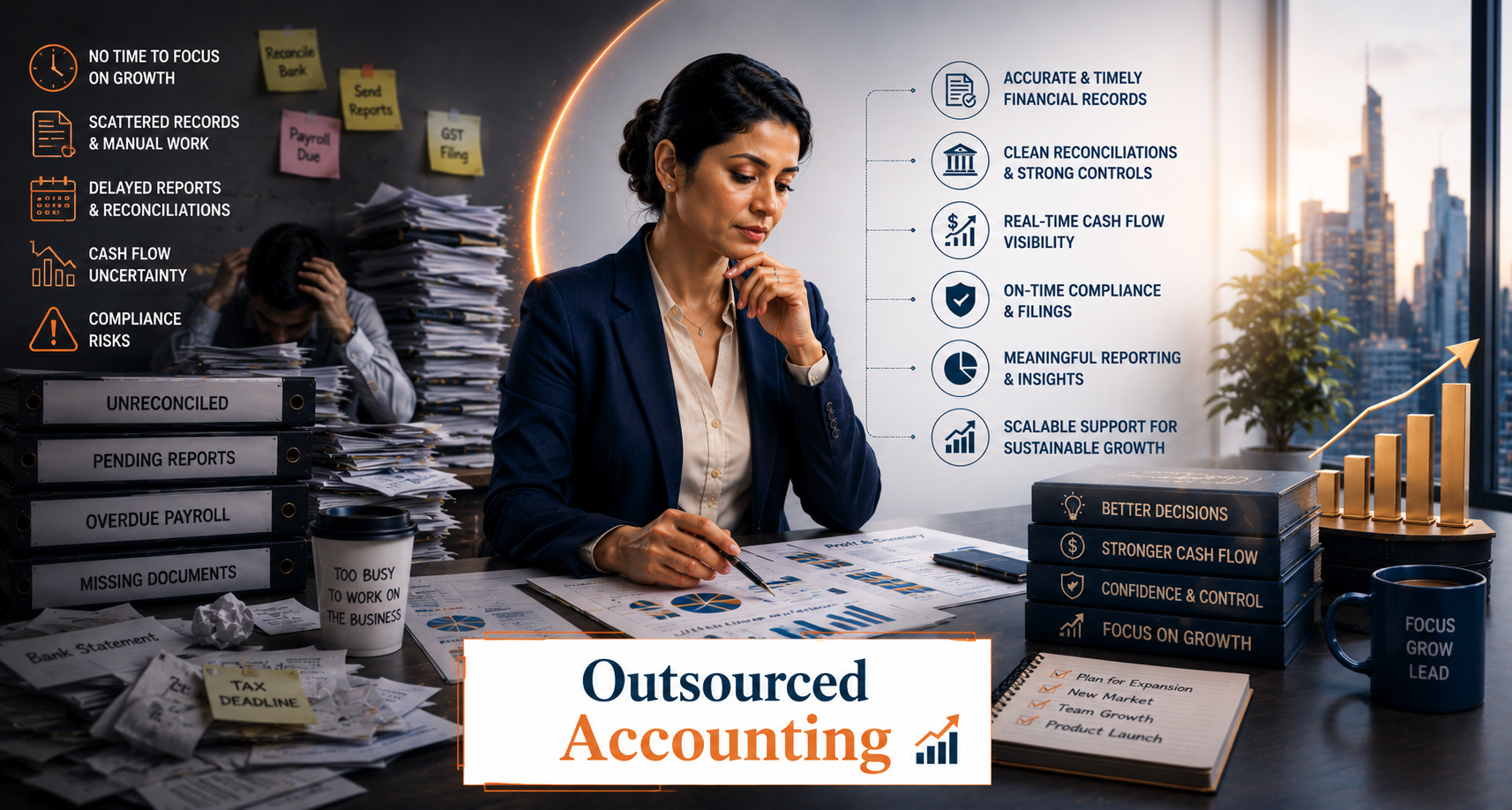
Benefits of Outsourcing Accounting for Small Businesses: A CPA’s Strategic Guide
For many small businesses, accounting becomes expensive for the wrong reasons.
It is not expensive because the work is impossible. It becomes expensive because the work is delayed, fragmented, handled by overstretched people, or left to someone who is already managing too many tasks at once. The result is predictable: slower reporting, weaker cash-flow visibility, missed compliance items, and decisions made with incomplete numbers.
The reference article you shared makes this point clearly. It describes how small businesses today expect faster turnaround, informed insights, and competitive pricing while firms are dealing with staffing shortages and rising overhead costs. It also shows that outsourcing accounting and bookkeeping is no longer a niche idea; it is becoming a mainstream operating model for small firms and CPA practices trying to do more with less.
That is the real reason outsourcing accounting matters.
At Acumen Financial Solutions, we see the same pattern every day. Small businesses do not usually need more accounting noise. They need cleaner books, better visibility, fewer surprises, and a support model that scales with the business instead of slowing it down.
Why in-house accounting starts to break down
One of the most common mistakes I see founders make is assuming accounting can be handled “as needed” until the business gets bigger.
In practice, that usually means the books get updated late, reconciliations lag behind, payroll or compliance tasks get rushed, and management starts relying on old information. A business can grow revenue and still become financially less clear if the accounting process is not keeping pace.
The reference article reflects this same problem from the CPA-firm side: too much time spent categorizing transactions, reconciling bank statements, and handling payroll compliance takes away from growth-focused work. That same pressure exists inside many small businesses themselves.
When accounting stays too close to the founder or a single overloaded employee, the business does not just lose time. It loses visibility.
And once visibility drops, cash-flow planning, tax readiness, and business decisions all become harder.
What outsourcing accounting actually changes
What is outsourcing accounting for small businesses? It is the practice of moving bookkeeping, accounting, payroll, reporting, compliance, and related finance functions to a specialist team instead of trying to manage everything internally.
That sounds simple, but the business impact is much larger than just saving hours.
The reference article notes that small businesses increasingly use external service providers for accounting and bookkeeping because they want access to expertise, lower operational pressure, and better financial support. It also points to a strong post-COVID rise in outsourcing adoption, showing that this is now a serious operational choice rather than a temporary trend.
In practical terms, outsourcing changes four things.
First, the owner gets time back. That time can go into sales, operations, product delivery, service quality, or client development instead of spreadsheet cleanup.
Second, the numbers become more dependable. That matters because clean books are not just for tax season. They affect lending, vendor trust, investor discussions, and the owner’s own confidence in the business.
Third, compliance pressure goes down. A business that is behind on filing, payroll, or reconciliations often pays for it later through penalties, corrections, or rushed reviews.
Fourth, the business gains access to expertise that may not exist internally. The reference article highlights that outsourcing teams often bring software capability, payroll knowledge, compliance awareness, and reporting support that many small businesses would struggle to build in-house.
What expertise small businesses gain from outsourcing
Outsourcing is not valuable just because someone else is doing the work.
It is valuable because the right partner brings patterns, systems, and experience that a small business usually does not have time to develop internally.
A good outsourced accounting team has already seen the common failure points:
unreconciled bank accounts, inconsistent expense coding, payroll errors, GST mismatches, cash-flow blind spots, delayed month-end closes, and reporting that is no longer current by the time management sees it.
The article you shared also notes that outsourced providers can offer support across QuickBooks, Xero, Sage, payroll complexity, multi-state compliance, budgeting, and KPI dashboards. That combination matters because small businesses do not only need records. They need financial intelligence.
In my experience working with growing businesses, the real difference between average accounting support and strong accounting support is not whether transactions get entered. It is whether the team understands how those transactions affect decisions.
A business with clean books can answer better questions:
Where is cash getting stuck?
Which products or services are actually profitable?
Which expense categories are expanding too quickly?
How much working capital is really needed?
What needs to be fixed before the next tax cycle?
That is the kind of clarity a small business gains when accounting is handled properly.
Why outsourcing improves scalability
Growth is usually where in-house accounting starts to strain.
A small business may survive with one internal bookkeeper at low volume. But as revenue grows, transactions increase, payroll becomes more complex, compliance obligations multiply, and the business starts feeling the pressure of its own success.
That is where outsourcing becomes especially valuable.
Instead of hiring too early or carrying the wrong fixed cost base, the business can scale finance support in stages. The reference article makes this exact point: outsourced accounting helps businesses move from basic bookkeeping to full financial support as revenue grows, without the staffing cycle that comes with permanent hiring or seasonal scrambling.
This flexibility matters because small businesses rarely grow in neat lines. Some months are quiet. Some months are chaotic. Some periods need only bookkeeping. Other periods need reporting, payroll support, or compliance cleanup. Outsourcing allows the accounting function to move with the business rather than forcing the business to fit the accounting function.
Why security and compliance are still manageable
A lot of business owners hesitate because accounting data is sensitive.
That concern is valid. Financial records include banking details, payroll, tax information, client data, and compliance documents. But security concerns do not make outsourcing a bad model. They just make provider selection more important.
The reference article explains that outsourced accounting can be secure when providers use SOC 2 controls, bank-level encryption, NDAs, firewalls, two-factor authentication, and strong oversight practices.
The right question is not “Is outsourcing risky?”
The right question is “Does the provider have the controls, review systems, and confidentiality practices to manage the risk properly?”
At Acumen Financial Solutions, that is where structure matters. Our onboarding systems, QC systems, review layers, escalation workflows, internal SLAs, standardized reporting, workflow management, and compliance checklists are designed to create consistency, scalability, and predictable quality. That is how good accounting support becomes reliable instead of reactive.
What small businesses should outsource first
Not every accounting function needs to move at once.
The smartest approach is usually to begin with the areas that create the most friction or consume the most founder time.
For most small businesses, that means:
bookkeeping,
monthly accounting,
payroll management,
compliance filing support,
MIS reporting,
cash flow statements,
and cleanup or catch-up work.
The reference article supports this practical approach by showing that outsourcing works best when it relieves the highest-friction work first, while still leaving strategic decisions in the owner’s hands.
If the books are behind, start there.
If payroll is creating stress, start there.
If compliance is creating notices or anxiety, start there.
The goal is not to outsource everything blindly. The goal is to restore order where the business needs it most.
Why Acumen Financial Solutions is a great fit
Acumen Financial Solutions is a strong fit for small businesses because our model is built around how real businesses actually operate.
Every client gets a dedicated accountant. That means no ticket queue, no repeated handoffs, and no need to explain the same issue over and over. When a client needs help, they speak to people who already know the file, the business context, and the compliance pattern.
We also provide direct access to the senior team, which helps when a compliance matter or reporting issue needs quick judgment.
Our support structure is designed around practical business needs, not generic service promises. We currently support 1,000+ satisfied clients across startups, SMEs, and large enterprises, and we are managing compliance for a company with ₹800 Crore+ annual turnover. That scale matters because it reflects process maturity, not just service volume.
Our pricing is also structured for accessibility:
GST compliance for startups starts from ₹1,000/month only.
Monthly accounting & compliance starts from ₹6,897 + GST/month.
E-commerce accounting starts from ₹10,000/month.
Franchise business accounting starts from ₹10,000/month.
For clients who want weekly and monthly MIS reports, cash flow visibility, direct senior communication, and a team that takes responsibility instead of passing work around, Acumen Financial Solutions is built for that model.
We also use in-house proprietary tools that help reduce human errors while maintaining premium quality at a lower cost. That combination is rare, and it is one of the main reasons businesses choose us.
Learn more at https://acumenca.in.
Frequently Asked Questions
How much can small businesses save with outsourcing accounting?
Savings vary by business size, transaction volume, and the amount of accounting work being outsourced. The reference article notes that outsourcing helps businesses reduce the fixed cost of salaries, overhead, and staffing pressure while shifting to a more flexible service model. In many cases, the bigger gain is not only direct cost savings but also time savings, improved accuracy, and fewer compliance problems later.
Is data safe when outsourcing accounting for small businesses?
Yes, if the provider has the right security framework. The reference article specifically points to SOC 2 controls, encrypted cloud systems, two-factor authentication, NDAs, firewalls, and oversight procedures as the safeguards that make outsourcing manageable from a security standpoint. A serious provider should be able to explain how access is controlled, how files are shared, and how confidentiality is protected.
What services come with outsourcing accounting for small businesses?
Common outsourced accounting services include bookkeeping, bank reconciliation, monthly accounting, payroll management, compliance support, tax prep support, cash flow reporting, budgeting help, and KPI dashboards. The source article also notes that outsourcing teams often bring expertise in QuickBooks, Xero, Sage, and compliance-heavy workflows, which can be useful for businesses that need more than just data entry.
How quickly can I start outsourcing accounting?
That depends on how prepared the books are and how clearly the scope is defined. A business that has organized records, stable systems, and a clear workflow can usually transition faster than one that needs cleanup work first. The most effective starting point is usually one function, such as bookkeeping or payroll, followed by a wider rollout once the process is stable.
Can outsourcing help if my accounting is already behind?
Yes. Catch-up work and cleanup work are often where outsourcing creates the fastest relief. If the books are inconsistent, incomplete, or delayed, an external team can help restore order, rebuild reporting, and create a more reliable monthly routine going forward.
What kind of businesses benefit most from outsourcing accounting?
Small businesses with limited internal staff, growing businesses with rising transaction volume, founders who need more time, and companies that want more reliable reporting usually benefit the most. The reference article also notes that outsourcing has become mainstream among sole proprietors and small firms, which shows how common this operating model has become.
Should a small business outsource all accounting functions at once?
Not necessarily. Many businesses start with the highest-friction areas first, such as bookkeeping, payroll, or compliance, and then expand once the workflow is stable. That gradual approach reduces risk and helps the transition feel more controlled.
Why choose Acumen Financial Solutions for small business accounting?
Because the model is designed for real business pressure, not just transaction processing. Small businesses get a dedicated accountant, direct access to senior support, practical reporting, fast response times, and a structure built around consistency and accountability. We also support pricing plans that are realistic for startups, e-commerce businesses, franchise models, and growing SMEs.
Conclusion
Outsourcing accounting for small businesses is no longer just a convenience. For many companies, it is the difference between operating reactively and operating with control.
The strongest benefits are not only lower overheads. They include cleaner books, better cash-flow visibility, faster turnaround, stronger compliance, more dependable reporting, and access to expertise that is hard to build internally.
When the accounting function is structured well, the business becomes easier to run.
At Acumen Financial Solutions, that is the outcome we focus on: consistent quality, direct communication, and accounting support that helps small businesses grow without losing visibility or control.